crowdhouse — Swiss income-generating properties in co-ownership
As a pioneer, crowdhouse launched co-ownership of Swiss income-generating properties in 2015, inspired by the Swiss commons model — the centuries-old tradition of collectively held and jointly used assets.
What drove us: Switzerland is a success model — economically, socially, and institutionally. The value created here over generations should benefit the population living here. Not exclusively in the form of rising rents at the end of the month, but as broadly distributed ownership — wealth creation in many hands.
Our mission is twofold: We enable broadly distributed wealth creation in Swiss hands — and we actively contribute to the provision of housing in Switzerland. We do not merely manage existing stock, but create and preserve housing through targeted acquisitions, renovations, and property developments. Generations instead of quarters, ownership instead of participation, substance instead of speculation.
Today, more than 1,750 owners hold over 230 properties with us in the crowdhouse model, with a value of more than CHF 1.8 billion — transferable across generations, transparently managed, and supported from a single source.
What exactly is co-ownership of a property?
Co-ownership means that several people jointly own a property, each with a share registered in the land register.
The best-known form in Switzerland is condominium ownership — where an owner owns a specific apartment. That is not what crowdhouse offers.
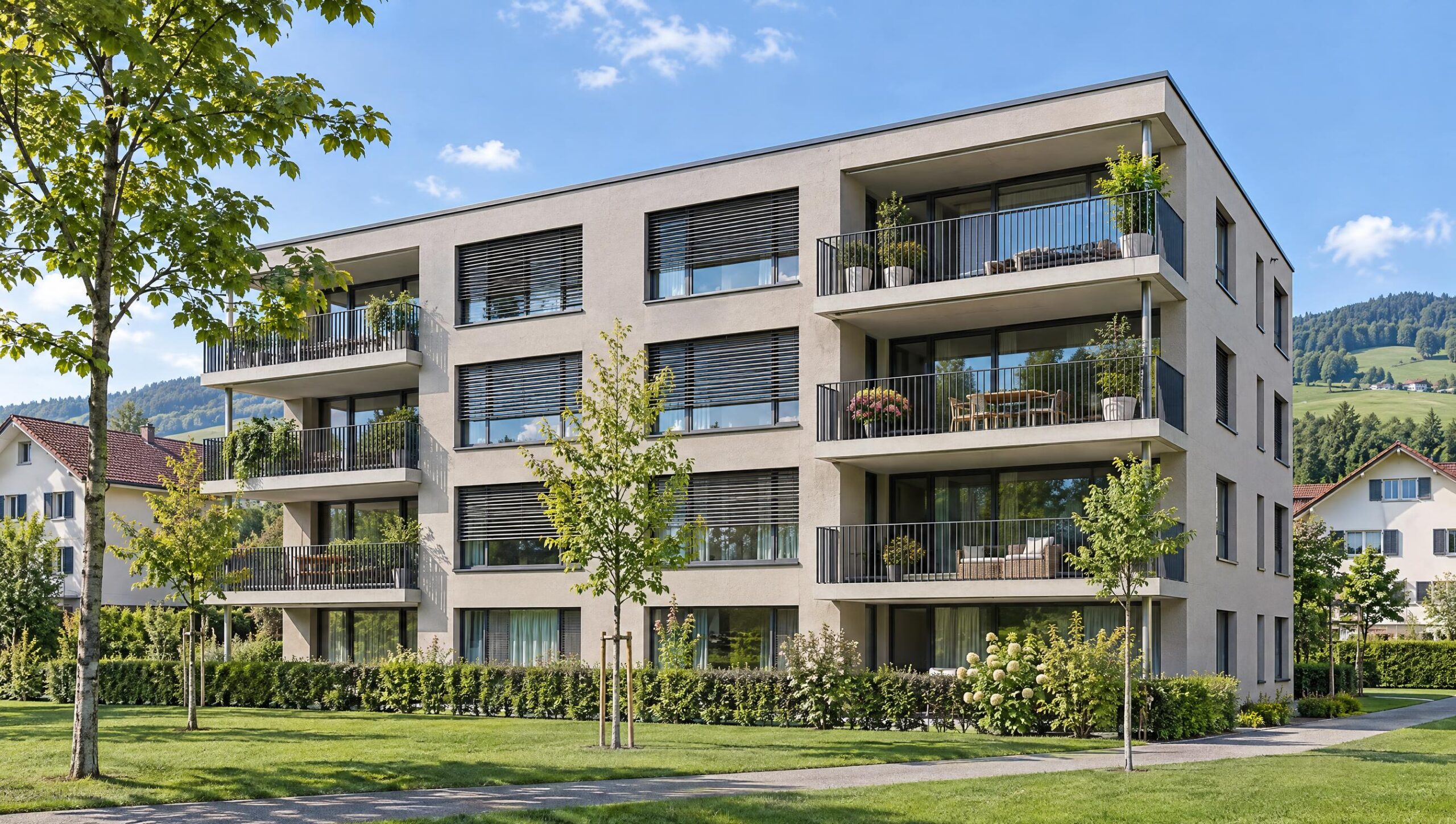
At crowdhouse, it is co-ownership of the entire apartment building: you become a co-owner of the entire property, proportionate to your share, with participation rights and a claim to a corresponding share of rental income and value development. This means you benefit from diversification across all apartments and tenants in a property — vacancy in an individual apartment or rent default by a single tenant does not affect you directly, but is smoothed across the entire apartment building.
We offer two forms of co-ownership:
- co-ownership — direct co-ownership with entry in the land register
- co-invest — co-ownership through shares in a Swiss stock corporation that holds exactly one property, open to qualified investors under CISA
Both are real ownership — no fund, no abstract basket, no contractual participation.
Is real estate co-ownership crowdinvesting?
No. In traditional real estate crowdinvesting, thousands of investors participate online with small amounts, often starting at just 100 or 500 euros, in a specific construction project — usually through a subordinated loan with a fixed term of 12 to 48 months and fixed or performance-based interest. This is not direct ownership, but the provision of capital; in the event of insolvency, investors are subordinated — up to and including the total loss of the capital invested. Crowdinvesting is therefore a short-term, contractual participation in a project.
At crowdhouse, it is something fundamentally different:
- Real ownership instead of a loan. You are either registered in the land register with your own share (co-ownership), or you hold shares in a Swiss stock corporation that holds exactly one property (co-invest). This is ownership of a tangible asset, not a subordinated loan.
- Cash flow plus value development instead of fixed interest. You receive monthly distributions from rental income and participate directly in the value development of your property — just as an owner should.
How does the acquisition of co-ownership of a property work?
We review, acquire, and structure selected apartment buildings. Each property is held in a co-owner community (co-ownership) or in its own Swiss stock corporation (co-invest) — each investor acquires a share or shares that are visible in the land register or securities account. The purchase process takes place via the co-owner platform, and the contract is concluded notarally or through regulated Swiss structures. After the acquisition, we take care of asset management and property management, reporting, and ongoing support — you receive monthly distributions from rental income and participate directly in the resulting value development when selling your shares.